
Susan Blow
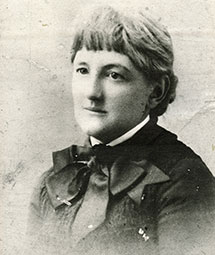
Susan Blow will be inducted into the 2026 Missouri Public Affairs Hall of Fame.
Induction Ceremony
- Thursday, Sept. 10
- 6 p.m.
- The Old Glass Place
Susan Elizabeth Blow was born June 7, 1843, in St. Louis, Missouri. Susie, as her parents called her, found her life’s calling in 1870 when she had the opportunity to observe some of the German kindergartens established by Friedrich Froebel, an educational philosopher who found pedagogical purpose in the act of play.
Blow’s experimental public kindergarten opened in the Des Peres School in the Carondelet neighborhood of St. Louis in September 1873. The following year, the St. Louis Board of Education, under the superintendency of Dr. William Torrey Harris, allocated funds for two more experimental kindergartens. These experiments proved successful by all accounts: most parents, teachers and administrators expressed approval of the kindergarten for various social and developmental reasons. In 1879, the first public kindergarten for African Americans opened in St. Louis, and by 1880, St. Louis had placed a kindergarten in every public school.
Blow’s kindergarten quickly moved from a St. Louis educational experiment to an American social movement. In the summer of 1876, visitors at the Centennial Exposition in Philadelphia saw her conduct classes in Missouri’s kindergarten exhibit, which exposed tens of thousands of fairgoers to this new public experiment in early childhood education.
Shortly thereafter, hundreds of men and women began to arrive in St. Louis from all corners of the United States to formally train under her. By 1880, there were more than 400 kindergartens in 30 states. The establishment of the International Kindergarten Union at the 1892 meeting of the National Education Association Institutional made clear that the social movement had attained national institutional support. By 1900, there were 1,365 public kindergartens in 189 U.S. cities.
Blow, mother of the American kindergarten, died March 26, 1916. In an era when women established more active roles in American civic and public life, she staked out a public profession and established a pedagogical practice. Her work spurred the American kindergarten experiment into a social movement and made it a mainstay of early childhood education in the U.S.